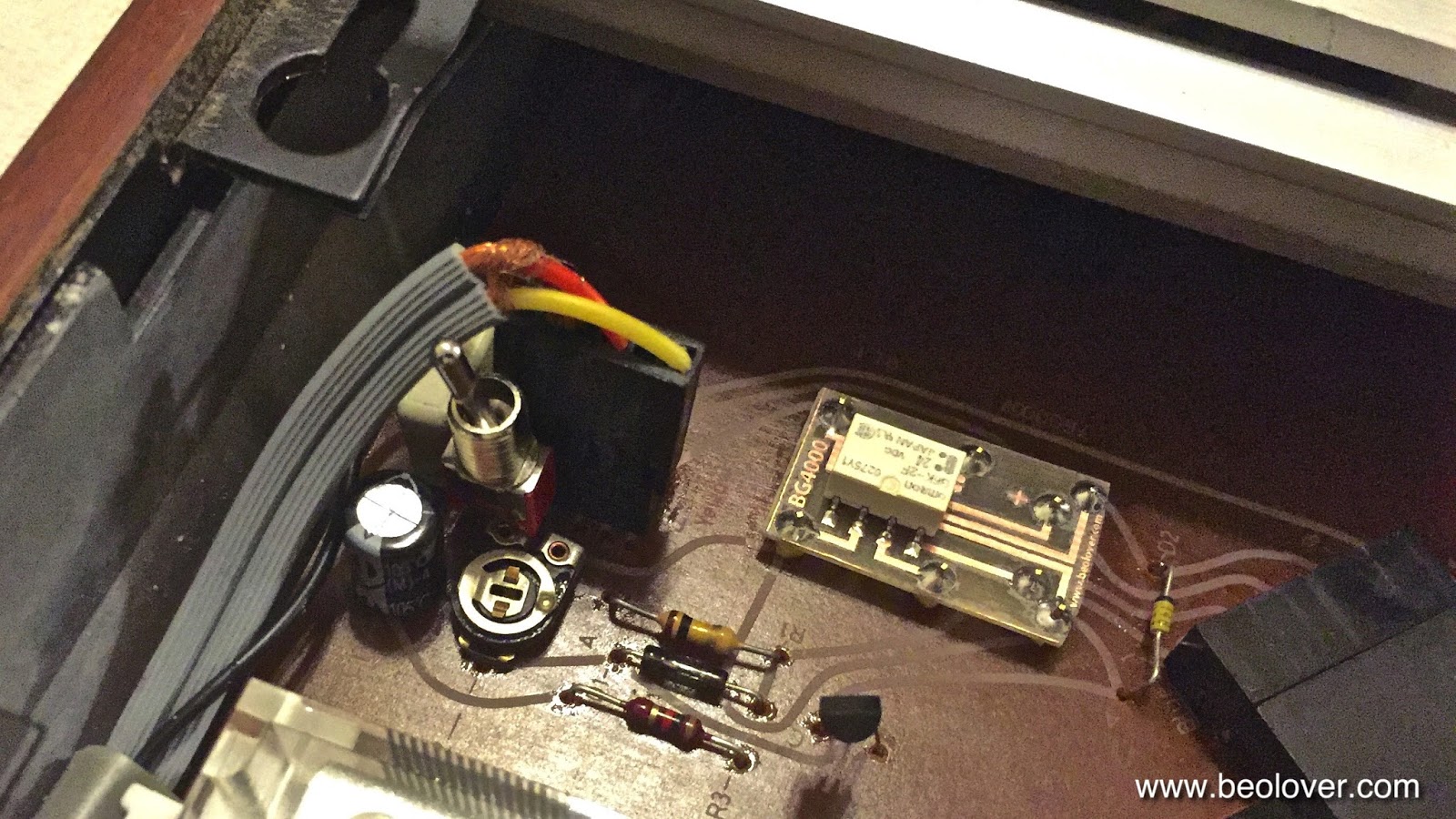
I thought I was pretty much done with the Beogram 4002 (5513) that I recently restored and I started testing it by listening to my favorite vinyls. After a while I realized that the RPM drifted over time. This was cured by replacing the original RPM relay with a drop-in replacement based on a modern encapsulated signal relay and exchanging the original principal 5k RPM trimmers on the circuit board with modern encapsulated multi-turn precision trimmers. Here are a few impressions:
This shows the original RPM relay on the main PCB:
And installed:
Above-left of the relay are the original 5k trimmers. I replaced them with these:
The lead-extensions were needed since I had to install them upside down to make sure that the set screws are accessible through the PCB from the solder side. Otherwise, it would be impossible to tune the RPM while the deck is running:
Here is a top-view:
This solved the RPM drift issue. However after a lot of listening to vinyls, most notably an original first pressing of a 12" single of Grace Jones' "Slave to the Rhythm", it became apparent that in addition to the drift phenomenon there was an other, more serious issue: Sudden sharp drops in RPM that would only occur on relatively rare but completely random occasions. Not so great! I decided to get to the bottom of this and I connect my oscilloscope to the signals around IC3 that controls the DC motor feedback control loop. To observe these signals while a record is playing one needs to solder jumper wires to the interesting signals of IC3:
This enabled to hook up my 4 channel oscilloscope:
Here are the traces that I measured during the occurrence of the phenomenon. Luckily once the issue started to happen it reoccurred a few times in a row, allowing me to capture traces with the single shot button. This shows the phenomenon at 33 RPM
and the much more frequently occurring analog at 45 RPM:
The traces are assigned as follows (see circuit diagram below): blue pin 1 (this is the AC induction signal from the DC motor feedback coils), yellow: pin 6 (this is the pulse width modulated output from the Schmitt trigger that corresponds to the amount of power the motor receives, green pin 7 (this is the RC network that determines the actual pulse width that the Schmitt trigger puts out, and red pin 4 (this voltage relative to the TR2 stabilized 8.5V output corresponds to the voltage the motor receives).

All this was pretty interesting: The DC motor of the Beogram 4002 (5513) is a 3-pole motor. This means that each of the three coils on the rotor is fully powered up every six commutator contact changes (see
here for some awesome animations and basic info). This suggests that the observed aberration in the pin 1 traces are related to one specific cycle of the motor rotation since the 'missing valley' phenomenon occurs every 6 wave cycles. So I took the motor apart again and throughly cleaned the commutator and the brushes and put it back together. This made the phenomenon much rarer but did not alleviate the issue completely. I may go ahead and put the motor of a parts unit in for now until I figure out how to fully fix this. The issue with intermittent problems is that they are intermittent. So it is difficult to make sure that a fix 'sticks' 100%. All this shows the principal issue with DC motors in turntables: They need a precisely working feedback mechanism to keep the RPM constant. All this is a non-issue with AC synchronous motors that simply 'obey' a sine wave that is fed into them.