Featured Post

Beolover SyncDrive: DC Platter Motor Replacement for Beogram 4002 and 4004 (Type 551x and 552x)

Late Beogram 4002 and the 4004 (Types 551x and 552x), which have DC platter motors instead of the earlier synchronous AC motors usually suff...

Showing posts with label powering up. Show all posts

Sunday, April 8, 2018

Beomaster 6000 (2702) restoration: checking, power-up and calibration

Everything is back into the chassis and now it's time to do a last check of all the wiring and powering up. It's important to make sure that no wires have been cracked, became loose or touching the chassis. This may seems obvious, but it is so important in a Beomaster 6000 quad because the space is so tight and most wiring is done with hard wires. I took all the time that I needed and found one wire broken off: a ground connection to the pre-amp.

So, a last peek inside before powering up......


I plugged the unit into my Variac transformer, gently raised the voltage to the required 230V and...........it fired up on all engines! I selected a FM station and listened to Katie Melua's version of Louis Armstrongs "What a wonderful world" ! And indeed it was......

That was a big relief. You never know what will happen after such a big restoration. But, off course, I had tested everything already before putting it al in the main chassis (check here). 

Some final calibration was now needed. I started with the power supply. I had done this before when restoring the power supply PCB, but under load settings may change. I found some slight variation. The +18V had now dropped to +17,85. Not to bad. And the -5V was now -5,1V (not sure why it went up). With the new trimmers in place, it was easy to recalibrate to the correct voltages.


On the same power supply PCB, a trimmer is located to balance the FM reception lights.

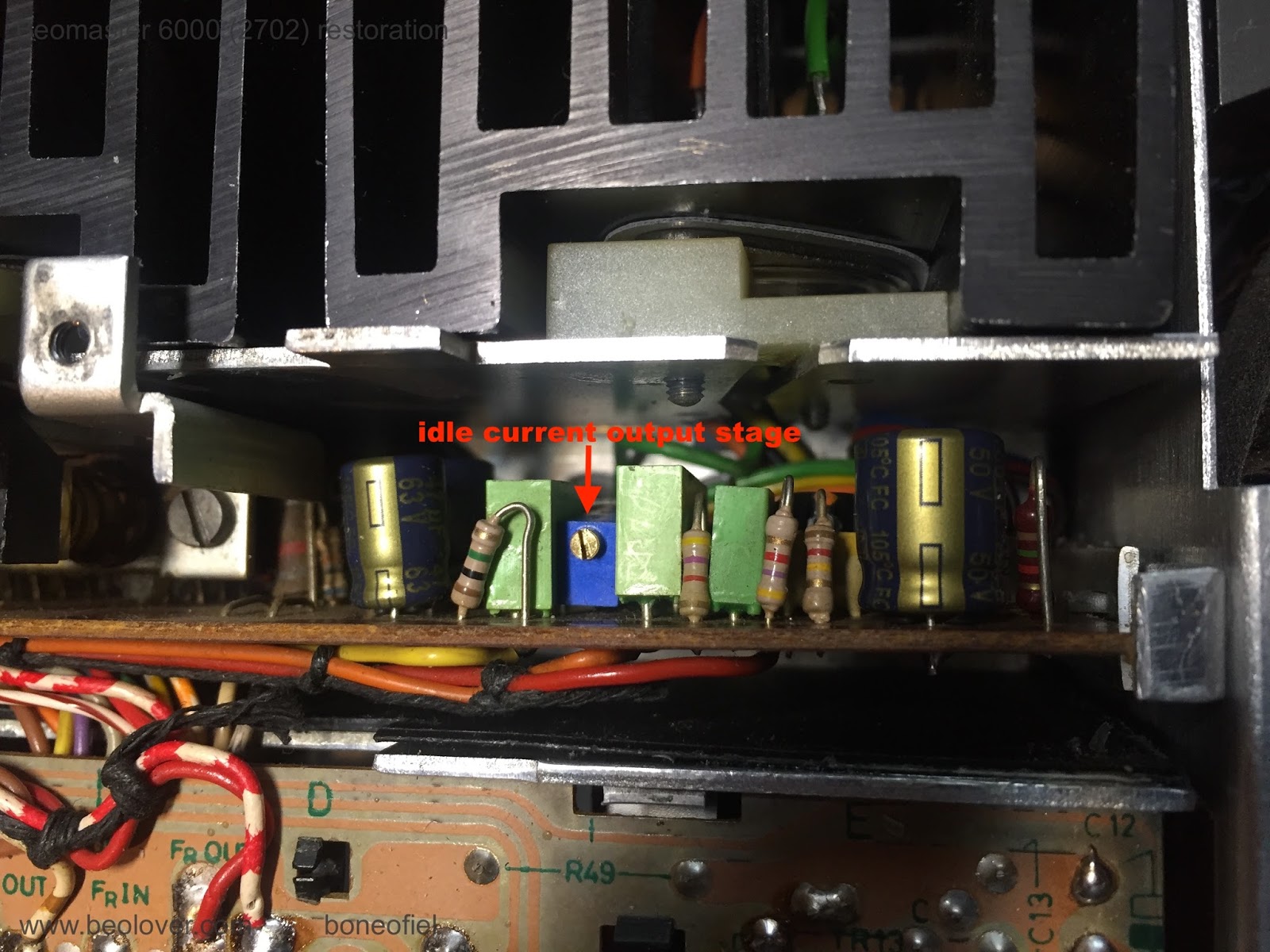
The idle (quiescent, bias or no-signal) current was already set before, but I checked it again by measuring the voltage drop over the 2 emitter transistors (0,12 ohm), in series, that are in each set of the Darlington output stages. The service manual describes to measure directly on one of the collector resistors on the PCB. They are very difficult (if not impossible) to reach once the PCB is in place in the subframe. The easiest way is to measure directly on the emitter contacts of both Darlington transistors (PNP and NPN pair) on the cooling elements (white & green wires in below picture). The correct setting in this case is 14,4mV (2x7,2mV). The extra base-emitter current that flows through the emitter resistors together with the collector-emitter current, is neglectable.


Next was the FM bottom voltage adjustment. The manual describes +4,5V. The FM tuner is driven by a variable DC voltage and to make sure that lowest FM frequency is correct and corresponds with the display, this bottom voltage needs to be set correctly.


Another series of adjustment are related to the FM display board with the signal strength meter, the stereo light and the tuning balance lights.


Other calibrations (like the ultrasonic receiver and the Commander remote) have been done before (see here).

Up next is the mounting of the FM display scale and fixing a new dial cord.

Thursday, February 22, 2018

Beomaster 6000 (2702) restoration: finishing re-assembling without chassis + testing

All the PCB's have been reconnected and time to check if all is working. I know, it looks a bit messy, but at least I got it all together on my piece of wood. I checked and rechecked all the wiring, looked for possible short-circuits, etc. 


Let's see if we can bring this mess to life ! Plugged it into my variac and slowly brought up the power. I saw lights coming on.........and the power relay kicking in. Yes !!!! No smoke or bad smell either :-)


I was a  happy man, but not for long sadly enough........Two major events happened. The first one: I could not select anything. The volume/tone/balance control was working. Motor and clutches running. I also did not get any bias current on the output stages (I had connected my multimeter before powering up to check). Hmmm.. No 60V DC rail either. I had checked the power supply before and all was working fine with the correct voltages. The 20V and 21,5V DC for the electronic switch are derived from the 60V DC, so that is why the switch is not working and no selection can be made (FM presets and input selection). Turned out the power relay did not make good contact to bring the 60V DC to the PCB's! The other voltages from the power supply PCB (18V DC, -5V DC and 180V DC) are not going through the power relay. I took the relay out and cleaned the contacts (again). But then decided to put in a spare relay that I knew was working fine. Powered up again and YES, not only lights but also switch board working and bias current. Measured over the output darlington emitter resistors and got about 4mV. Should be 14.4mV DC but I had set the multi-turn trimmers to almost minimum to be safe ! Plugged in 4 speakers and got music on all 4 channels! Time to relax a bit and take a drink...

And now the second event: when I came back a few minutes later (with my drink...) the music was still playing and I wanted to raise the display a bit because I could not see it very well. A big electrostatic discharge between my fingers and the display and 2 channels out with big hum. Disaster arrived....It's freezing cold over here, heating turned up, dry air, rubber shoes, synthetic sweater, chair with synthetics and rubber wheels,...The perfect "ingredients" to get my body fully charged with static electricity!! Should have known better. Half an hour later and 5 transistors replaced (all in the output stage) and everything was back to normal.


Now it was time to finish my drink.....