Featured Post

Beolover SyncDrive: DC Platter Motor Replacement for Beogram 4002 and 4004 (Type 551x and 552x)

Late Beogram 4002 and the 4004 (Types 551x and 552x), which have DC platter motors instead of the earlier synchronous AC motors usually suff...

Showing posts with label rubber. Show all posts

Friday, May 13, 2022

Beogram 4002: Plexiglass Hood Restoration

The Beogram 4002 (5523) that I restored recently came with a fairly scratched up hood. The good news was that the hinges were not cracked, and that the inside of the hood was almost undamaged. Only a few cleaning 'swirls'. So it was worthwhile trying polishing the hood back to a decent appearance. This shows the hood like it looked when I received the Beogram:

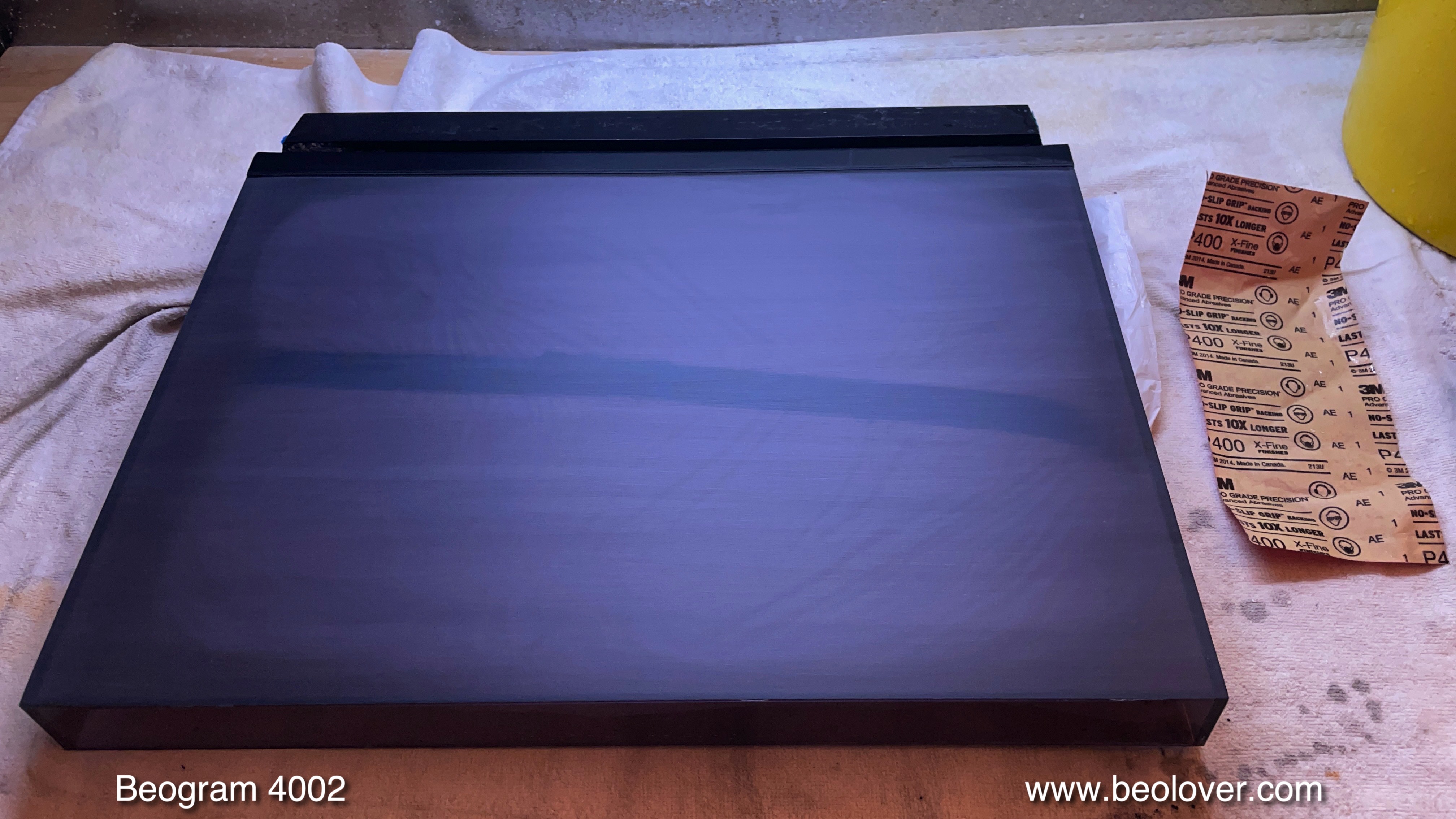
Since some of the scratches could be felt with a fingernail, I started with a 400 grit sand paper and 'equalized' the surface:

This removed all the bigger scratches along with the light ones and turned the hood into a matte, but homogenous surface. This is the usual starting point for polishing it back with ever finer sandpaper. After my usual 7 steps the hood was translucent again and looked pretty decent:

Of course, such polishing efforts are never perfect, and such a hood will never look like a newly moulded one. But this definitely looks much better than the original appearance!

Most 400x hoods have missing rubber bumpers that were supposed to soften the noise when the hood drops by its own weight onto the wood plinth. This shows one of the worn off bumpers. Usually there is still some rubber left in the mounting holes:
Before installing new rubber, the remnants need to be removed. It works well using a 2 mm drill bit for 'drilling' the degraded rubber out of the holes:
After this step it is time to install new rubber. I usually use snippets from 2 mm O-rings that I glue into the drilled out holes with super glue gel. Once the gel has hardened, I cut the snippets to a 1 mm length relative to the Plexiglass surface:
This gives the hood the original smooth 'plonk' sound when it is dropped by its own weight. Beolovely!


Friday, June 19, 2020

Beogram 4000: Hood Restoration - Exchange of Trim, Fixing Cracked Hinges, Spray Painting Corroded Metal Parts and Polishing

The Beogram 4000 that I am restoring right now came with a less than perfect hood. This hood 'had it all': Badly scratched plexiglass surface, corroded metal hinge parts, cracked plexiglass around the hinge area, and a wobbly plastic imitation aluminium trim strip (as it was standard on the early 4000). 

I set out by removing the plastic trim strip. Since it is attached with contact cement, I needed to bake the hood for a while in the oven at the 'warm' (~80C) setting. For this it is best to wrap it in aluminum foil to avoid hot spots:
After about 45 min in the oven
it was time to remove the trim. It can simply be pulled off from the warm hood. This leaves a bunch of contact cement residue behind:
This residue can be easily removed after soaking it in isopropyl alcohol for an hour or so. To do this I put isopropyl soaked paper towel on the glue
and covered it with aluminum foil to prevent evaporation:
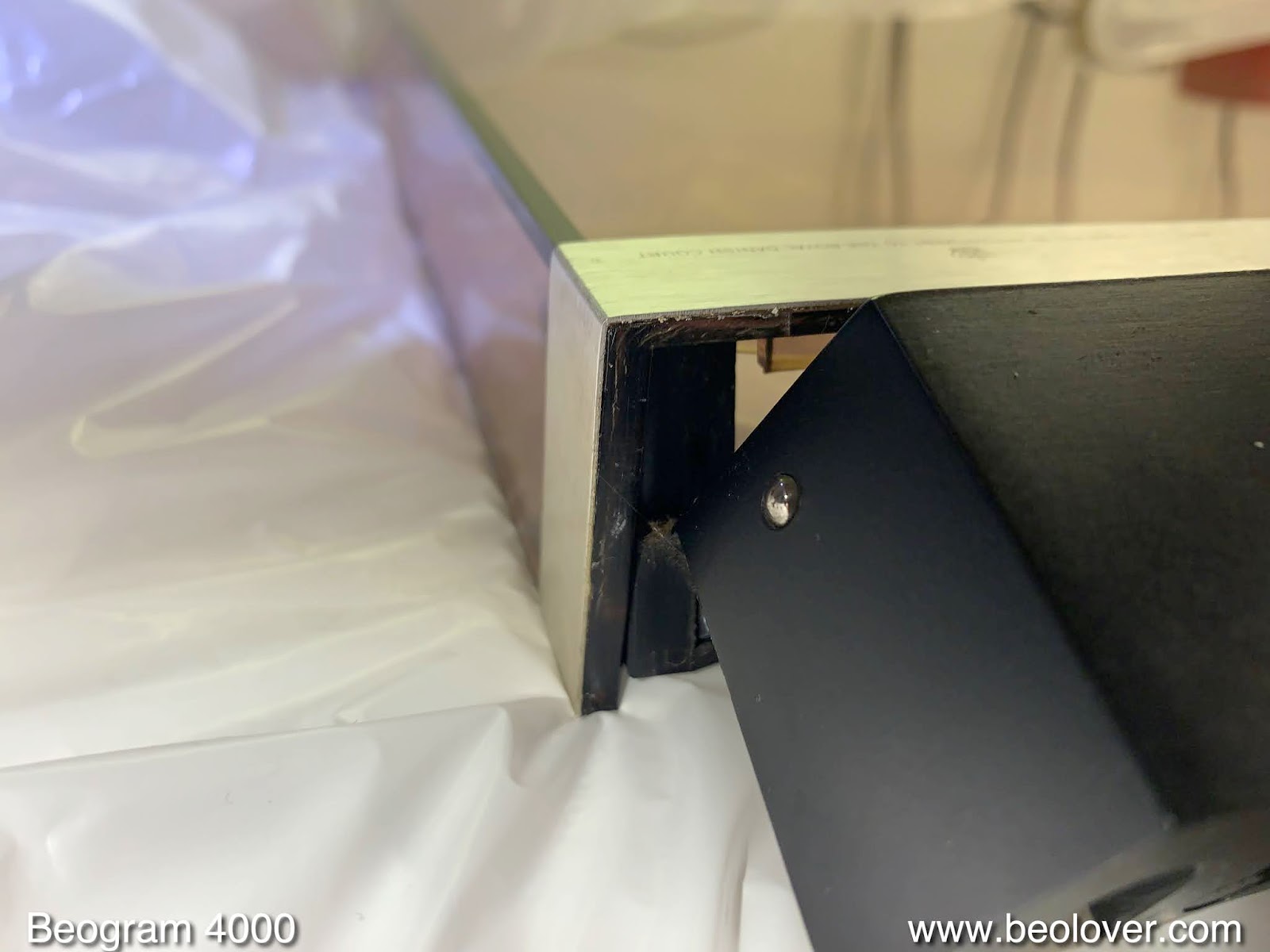
After I wiped off the softened contact cement, it was time to fix the cracked hinges. Both sides had almost identical stress fractures around the bottom screw holes, a common issue with these hoods:
Since the cracks were still minor, this was a perfect application for my hinge patch kits, which consist of two patches and custom designed clamps that fit precisely on the patches:
This shows one of the kits installed, ready for plexiglass solvent to be applied:
The final result looks like this:

The patches are pretty thin, but they make the plexiglass a bit thicker, the price for having a stable attachment point for the hinge again. The application of the clamps causes some of the dissolved plexiglass to 'squirt' into the bolt holes, i.e. one needs to rout them out with a drill bit or similar after this repair process.
Now it was time to polish the hood, which looked like a used up ice rink after a skating competition:
I started out with 400 grit to remove the scratches:
This makes it homogeneously dull. After that the two hour process of polishing it back began. A nice workout in the garage!
I also repainted the corroded metal hinge parts:
This can be done fairly well by sanding the paint down and repainting the surface with black satin spray paint. This yields 'close-to-new' results:
After bolting the hinge back into the polished plexiglass hood, it was time to install an original Beogram 4000 aluminum trim, that I removed from a cracked 4000 hood (the result of a sad ebay experience with a seller who did not follow my packing instructions)
The application of contact cement to the hinge benefits from covering the area next to the strip with blue tape:
I brushed the contact cement on with a small cut to size foam block. It is essential to generate a smooth thin film. Otherwise the trim will be too high and not flush anymore with the hood.
Application of the cement to the aluminum trim strip is straight forward. When applying the strip to the hood, it is important to protect the contact cement from touching until the strip is moved into its precise location. This is helped much by placing a strip of parchment paper in between the strip and the hood:
Once properly positioned the paper can be pulled out and the strip pressed into the recess on the hood.
Since the hinge repair patches made the plexiglass a bit wider, it was necessary to conform the aluminium strip to the new shape. I did this with special clamps that I designed for these hoods a few weeks back:

They allow generating fairly high pressure on the strip, which creates a fairly conforming fit:
But a slight bulging due to the patches is unavoidable. 
The final step was to install new rubber bumpers on the front corners of the hood, to ensure a satisfying 'thunk' when closing it. I usually drill out the old degraded rubber with a 2 mm bit by hand, and then super glue a snippet of a 2 mm O-ring into the hole.
Trimming it to 1 mm length completes the installation:

And this is the final result:
Beolovely!


Monday, May 25, 2020

Beogram 4000: Hood Restoration - Polishing and Exchange of the Hinge

The Beogram 4000 that I completed recently still needed its hood restored. Of the two hoods I received, one had a crack up front at the left corner, while the other had a decent plexiglass body, but the hinge showed corrosion blooming under the black paint:
This is a frequent issue with Beogram 4000 hinges, and one can fix it by sanding the hinge down and then repainting it with black matte spray paint. But the better solution is to find a hinge that does not have this issue, since spray paint is never perfect. Luckily, the cracked hood had a near perfect hinge, and so I decided to exchange them.
Taking the hinge out is not difficult, but one has to get under the easily damaged aluminum  strip that graces the hoods in the back. This can be done by carefully inserting a razor blade between the plexiglass and the strip:
One needs to be careful to not damage the plexiglass around the strip or the strip itself. They easily break off at the bend. So it is best to not bend them out too much. This is enough:
It is important that it also comes off a bit at the bottom, which usually happens due to the age of the glue - if it does not: It may be best to heat the hood to ~70C in the oven and then carefully pushing the strip down at the bottom. The heat softens the glue making it come off much more easily. But let it get too hot, and the plexiglass starts deforming, so it is a bit of a scary thing to do. Luckily in this case the strip came off fairly easily without too much convincing necessary, so I did not have to go to the oven treatment. Once the strip is off, just remove the two screws on both sides and the hinge comes off. The replacement is easily bolted in and then the remaining task is to glue the aluminum strip back on. 
In the past I used double sided tape, but I had to realize that in some cases the strips lifted off again after a few months. Pretty un-beolovely! Therefore, this time I decided to try out contact cement, which, I think they also used initially when they made these hoods.
The first step is to remove the old glue, which can be softened by placing paper towel wads drenched with isopropyl alcohol into the gap and let it sit for ~30 min:
After this treatment, the glue can be scraped off with a razor blade:
Now it was time to apply a thin layer of contact cement to both sides with a tooth pick. I use this (Amazon):
It is important to not apply too much cement, and also stay ~1mm away from the front edge of the strip, since some glue can be squeezed out there when the parts are pressed together. 
After the cement is fully dry (~15 min) the strip can be pressed into place. Since the strength of contact cement bonds strongly depends on the force and duration applied when pressing the parts together, I developed a set of clamps specially designed for the task (it is difficult to just use carpenter clamps or similar due to the irregular shape of the hinge mechanism):
I pressed the strips back into place by hand and then applied the clamps:
I let everything sit for a day, and then removed the clamps:
Nice how precisely the strip conforms around the corners! Beolovely!
After this it was time to polish the hood, since it was pretty scratched on top:
I started out with sanding it with a 320 grit until all the scratches were gone, and then I polished it back up to translucency in 10 steps with ever finer grit and finally with polishing compounds. A nice 2 hrs workout in the garage, and then the hood looked pretty nice again:
The final touch was to install new rubber bumpers for that satisfying 'plonk' when closing the hood. The original ones are usually gone at this point in time since the rubber degrades over time:
The sticky remnants of the old rubber can be drilled out with a 2 mm drill bit:
(be careful when you try this at home - it is easy to break out the plexiglass corner if one is not careful during this procedure). Once the old stuff is gone, a new piece of 2 mm O-ring can be glued into place with super glue gel. Once the glue is hardened, cut the O-ring snippet to 1mm length above the plexiglass:
Allright! Another Beogram 4000 re-hooded! Soon I will send this beauty back to its owner!


Thursday, April 18, 2019

Beogram 4004 (5526): Restoration of the Plexiglass Hood and a New DIN5 Plug

The restoration of the Beogram 4004 (5526) that is on my bench is almost finished. Today was hood polishing day. This usually means a nice workout at the work bench in the garage with some sand paper and polishing compound. Fun! This shows some of the scratches on the hood as received:

If one can feel the scratches with a fingernail, the hood needs to be sanded first to create a homogeneous surface. The scratches of this hood required a few minutes of sanding with 320 grit for equalization:
Once all the scratches are gone, it is time to roll up the sleeves and polish it back to translucency. This requires 8-10 steps of ever finer sand paper finished up with polishing compound. This is how the hood looked about 2 hrs later:
Pretty shiny, but of course not as perfect as a new hood.
The final step of a hood restoration is always the renewal of the rubber bumpers, that make sure the hood closes with a happy sound. As is the case with most Beograms at this point in time, the bumpers were broken off:
They can be replaced with pieces of 2 mm O-ring that are glued into the original cavities. But first the old rubber needs to be removed with a drill bit:
 Then the O-ring snippets can be glued in:
And trimmed to about 1 mm length once the glue has hardened:
With the final result looking like this:
After the hood was done, I moved on to replace the original oxidized DIN5 plug
with a modern all-metal DIN5 plug with gold plated contacts:
Beolovely! All this Beogram still needs before I can give it a spin is a few adjustments.