Featured Post

Beolover SyncDrive: DC Platter Motor Replacement for Beogram 4002 and 4004 (Type 551x and 552x)

Late Beogram 4002 and the 4004 (Types 551x and 552x), which have DC platter motors instead of the earlier synchronous AC motors usually suff...

Showing posts with label damping. Show all posts

Saturday, October 31, 2015

Beomaster 8000: Volume Encoder Damping Restoration - The Final Answer

The Beomaster 8000 that is currently on my bench had lost all damping of the volume rotary encoder wheel. This issue is more than a cosmetic one, since damage can occur to the speakers if they are not dimensioned properly if someone accidentally spins the volume encoder up to 6.0. Without damping this can easily happen if attention is not being paid. Up to now I used a method to restore the damping that was based on a 3D printed paddlewheel that I clamped on the back of the encoder shaft and then filled the cavity with a high viscosity damping grease. While this worked fairly well, I always had the feeling I was on the wrong track with this. So yesterday, I finally took the plunge and opened up the volume encoder to have a look under the hood with the goal to understand how the original damping had been done. After taking out the encoder sensor assembly I cut the retaining clips off with a wire cutter (unfortunately this seems to be the only way to get them off) and removed the encoder:

It is held by four adhesive strips and I needed to use a screwdriver to lift it up one corner at a time. Once I had it out I thought what a beautiful big design compared to today's encoders...Anyway, once the encoder is off, one can simply pull out the wheel from its precision sleeve bearing:

And after I saw this everything was clear: The original damping was simply done by putting some damping grease on the shaft and then inserting it back into the bearing. Due to the fairly tight fit this creates a nice damping effect. Unfortunately, over time this grease is entropically driven out of the bearing, and the damping effect wanes gradually. I put some Nyogel 767A on the shaft

And inserted the wheel into its bearing and the wheel was damped again. I put the encoder assembly back onto its posts and clamped it down with new 3mm retaining clips and nylon washers to protect the encoder housing in case it needs to be opened up again in another 20 years for a re-greasing:

Then I adjusted the plexiglass clamp in the back to ensure scraping free operation while being flush with the surface of the Beomaster keypad. I guess the evolution of my fix to this issue is another example of live-and-learn. I should have taken one apart much earlier...;-).


Wednesday, January 21, 2015

Beomaster 8000: Volume Wheel (Encoder) Damping - 3D Printed Paddle Wheel

This is a follow up to my last blog entry about restoring the damping of the Beomaster 8000 volume wheel rotation. Often, the volume encoder looses all its damping over time, which can create an unpleasant situation when someone uninitiated to the issue accidentally cranks up the volume to 6.0 because the volume wheel does not stop spinning.
My latest solution involves a 3D printed 'paddle wheel' that press-fits on the volume encoder shaft. Together with a more heavy duty high viscosity damping grease, the Nyogel 767A a very smooth purely viscous damping effect can be achieved. I made a short video about the new part and its installation:


Here is a better picture of the part (printed with a Form 1 stereolithography printer):


Saturday, September 27, 2014

Beomaster 8000: Volume Wheel (Encoder) Damping - The Video

I really like my Beomaster 8000 with yesterday's volume wheel damping update! So I decided to implement the same approach in the 8000 that will go to Australia next week. Can't let it go less than perfect!...;-). I used this opportunity to make a short video about the procedure. Enjoy!


Friday, September 26, 2014

Beomaster 8000: Volume Wheel (Encoder) Damping - Better Solution

*********Note: There is an update to this entry where a 3D printed part is used as paddle wheel to increase the interaction with the damping grease*****************************************


I was not really happy with my recent Beomaster 8000 volume encoder damping restoration effort. So I tried a few more things on one of my own 8000s. I realized that the original damping must have been a very heavy damping grease to achieve a sensible damping of the volume wheel. I ordered a sample kit of damping greases from Nye. I tried out their highest viscosity type, 868VH, but this still did not yield a damping as strong as I would have liked it.

After some deliberation, I realized that torque is the issue, and I decided to increase the radius of the encoder shaft for a higher damping force. I found a piece of 3 mm silicone sheet in my stash, and I drilled a 3 mm hole into it, and then cut around it:


The irregular shape results in some added turbulence in the grease. When installed the piece spun freely on the encoder axis, i.e. did not rub significantly on the grease well housing. This ensured a smooth rotation-feel of the encoder, only damped by the viscosity of the grease.

Here are the pics after installing the silicone piece and adding the Nye 868VH damping grease:


I pushed the grease in with a toothpick. Then I installed the cover and wiped the excess grease off:


It is important to adjust the screw properly to hold the wheel in a position flush to the panel surface when it is installed horizontally. Make sure that the wheel does not scrape the housing when turned. The above procedure yielded a damping which reduced spin to about 0.5 rotation when giving it a pretty hard spin. Let's see how this repair fares over time....


Saturday, September 6, 2014

Beomaster 8000: Volume Wheel (Encoder) Damping

********This is a historic post. Please, Check here for an updated procedure.******************

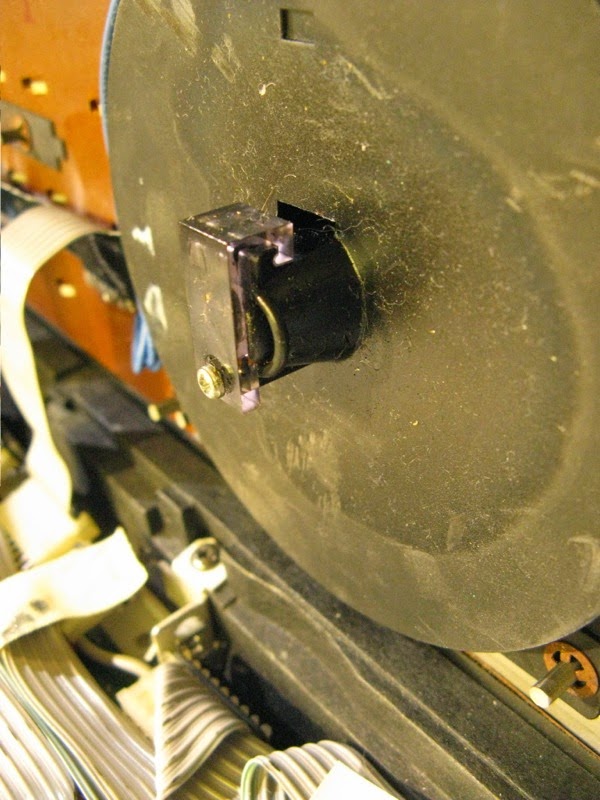
After the displays were back in the Beomaster 8000, I remembered that the volume encoder wheel had lost all its damping. The picture below shows the backside of the encoder housing (this is actually from another Beomaster, I forgot to take a pic of the assembled feature). Together with the plastic 'clamp' an O-ring seals a compartment where a viscous material can be inserted to dampen the rotation of the encoder. In the case of volume adjustment, this is desired to avoid any accidental 'dial-up' of the volume by the inertia of the fairly heavy metal wheel (think having a party with many happy people interested in your Beomaster...;-).


Geoff at Beoworld.org recently told me that he fixed the damping by putting in some high viscosity grease into the compartment, which worked great. So, I put in Silicone grease (which is the least problematic grease in terms of 'interaction with other materials', i.e. one can expect it to be inert in most settings). Here is a pic:


I also needed to replace the O-Ring. I used a Buna Nitrile 1/2"ID X 5/8"OD X 1/16"CS ring from theoringstore.com, which seemed to have about the dimensions of the old deformed ring.

This procedure resulted in a fairly well damped encoder.

Time to put the Beomaster back together!